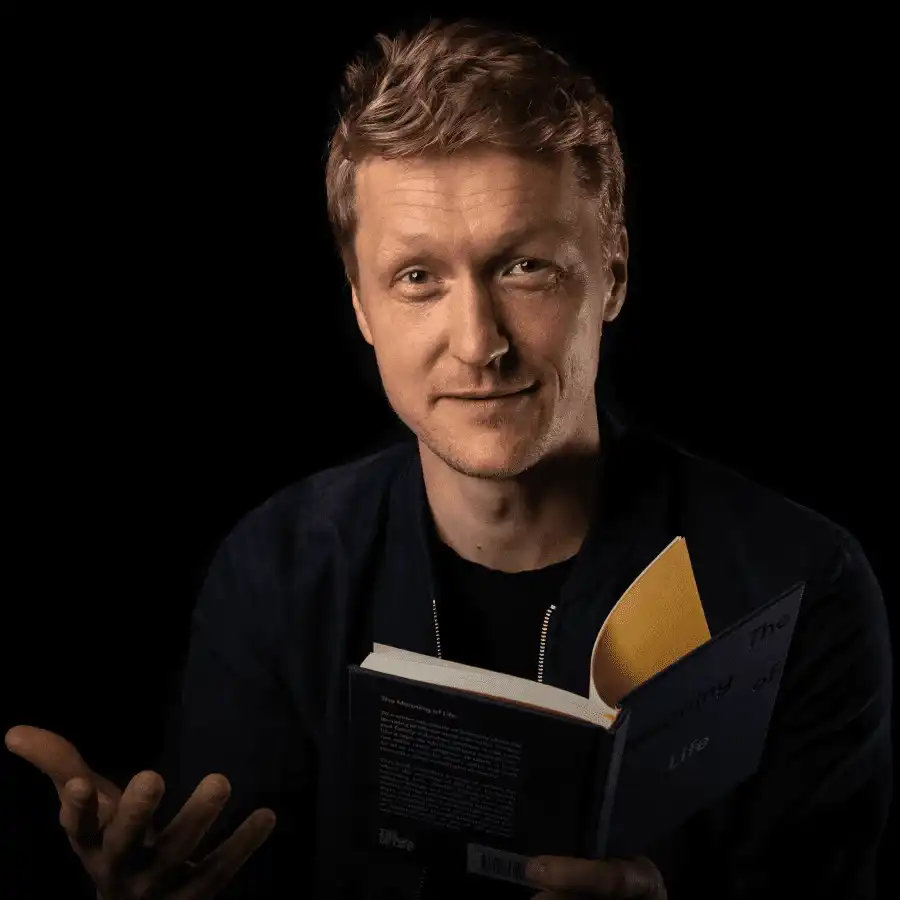
Dr. Martin Ebeling is a philosopher, leadership expert and heads the business program of The School of Life in Germany. He has made a name for himself in the past by helping hundreds of leaders to develop their potential. His experience taught him that success and happiness are the result ofgrowing with your challenges. He is also the author of numerous scientific-philosophical essays.
All sessions by Martin →Coaching is a crucial skill to develop the potential of individual employees and to inspire a culture of learning and growth in an organization. In this session, we will explore the difference in attitude and practice between managing and coaching someone, explore what lies at the foundation of the relationship between coach and coachee, learn to ask the right questions and get to know a specific coaching technique that we can use to inspire growth in others.
Just as important, we will ask when coaching might not be the method of choice and explore ways of spreading the coaching mindset across the entire organization.
During the expert session, Martin Ebeling engages the audience through interactive exercises using the Mentimeter app, open-ended questions for reflection and perspective-shifting discussions, and live demonstrations showcasing the GROW technique in coaching scenarios. These activities help participants grasp the importance of active listening, empathy, and asking effective questions in modern leadership and coaching roles.
These key learnings highlight the importance of adaptability, active listening, and open communication in fostering organizational growth through modern management and leadership styles. By embracing these principles, individuals can effectively coach their teams, build strong relationships, and navigate complex situations with confidence and empathy.
In this expert session, Martin Ebeling discusses the transformation of traditional management into modern leadership and the role of coaching in organizational growth. He begins by explaining that modern managers must keep up with the latest processes to optimize results while recognizing that leadership is no longer limited to top-level positions.
Instead, it has diffused throughout the organization, requiring lower and middle management to innovate and formulate strategies.
Martin introduces two main pillars of modern leadership: agility and coaching. Agile organizations demand flexibility from leaders at all levels who can adapt quickly, solve creative problems, and collaborate with internal and external stakeholders.
Coaching, a crucial third pillar, focuses on developing individuals' potential in a supportive way.
Martin explains that managers provide instructions, monitor progress, and ensure plans are implemented, whereas coaches offer support, focus on the person, and help individuals find their own solutions. Coaching relationships are collaborative, allowing both parties to uncover inner wisdom and strengths.
However, Martin advises that managers and coaches may need to wear different hats depending on the situation.
Martin highlights the importance of open-ended questions in leadership and coaching, which can build relationships based on genuine curiosity and interest in others while facilitating problem-solving and learning. He discusses the differences between guiding questions and diagnostic questions and emphasizes the significance of reflecting on personal experiences to learn effectively.
Additionally, Martin touches upon the importance of active listening, providing space for individuals in conversations, and recognizing that asking questions is not just about seeking information but also encouraging engagement with your thought process.
No prior knowledge is assumed. It is built for a general working audience, and people who already know the subject get the research and the practical side rather than an introduction. What the hour itself covers: Coaching is a crucial skill to develop the potential of individual employees and to inspire a culture of learning and growth in an organization. In this session, we will explore the difference in attitude and practice between managing and coaching someone, explore what lies at the foundation of the relationship...
It is interactive, and the block higher up on this page says exactly how for this session. Nobody has to speak up who does not want to: the chat and the polls carry most of it, and the questions can come in anonymously.
It runs 45 min / 15 min: the talk, then live questions. All you do is pick a date. We brief Martin, produce the session, host and moderate it, run the Q&A, and send you the report within an hour of the end.
A team, a department, an employee network or every single employee at once, with no cap and no per-seat price. It runs inside your own Microsoft Teams, Zoom or Google Meet, or on a branded page we build. No integration, no login, no company device or e-mail.
The session is delivered in English, German. You can add high accuracy live subtitles in 8, 16 or 24 languages, so everyone follows in their own. That is a paid option, priced by the number of languages you need.
No, and that is by design. There is nothing to install, nothing to integrate and no connection to your systems, so there is nothing for IT to validate: we join your own Teams, Zoom or Meet as a guest speaker, or we host a page and your people open a link. No software, no accounts, and no data of yours that we can reach. It is why hundreds of companies, among them some of the largest technology and financial firms in the world, were able to start within a day.
We never receive or hold personal data about your employees. Because the session runs in your own environment, attendance and identity stay with you, and what we report back is aggregated: numbers, ratings and survey answers, not people. That is also why IT approval usually takes minutes rather than weeks.
This one is live only. You also get attendance over time, participant ratings for the content and the speaker, the survey answers, and the topics your people asked for next.
"People will forget what you said... but people will never forget how you made them feel," - Maya Angelou This hands-on workshop…

Psychological Safety is a well documented driver of high performance in teams and organisations.
How do successful people, teams, and organisations become even more successful?
- Session available on-site only - Sometimes, the way we approach a problem becomes the problem itself, but we may not be aware…

In a world of uncertainty, we cannot always control all the bad things that happen to us, but we can control the way that we…

At this point, the integration of AI in the workplace seems inevitable as many professionals are using it daily.