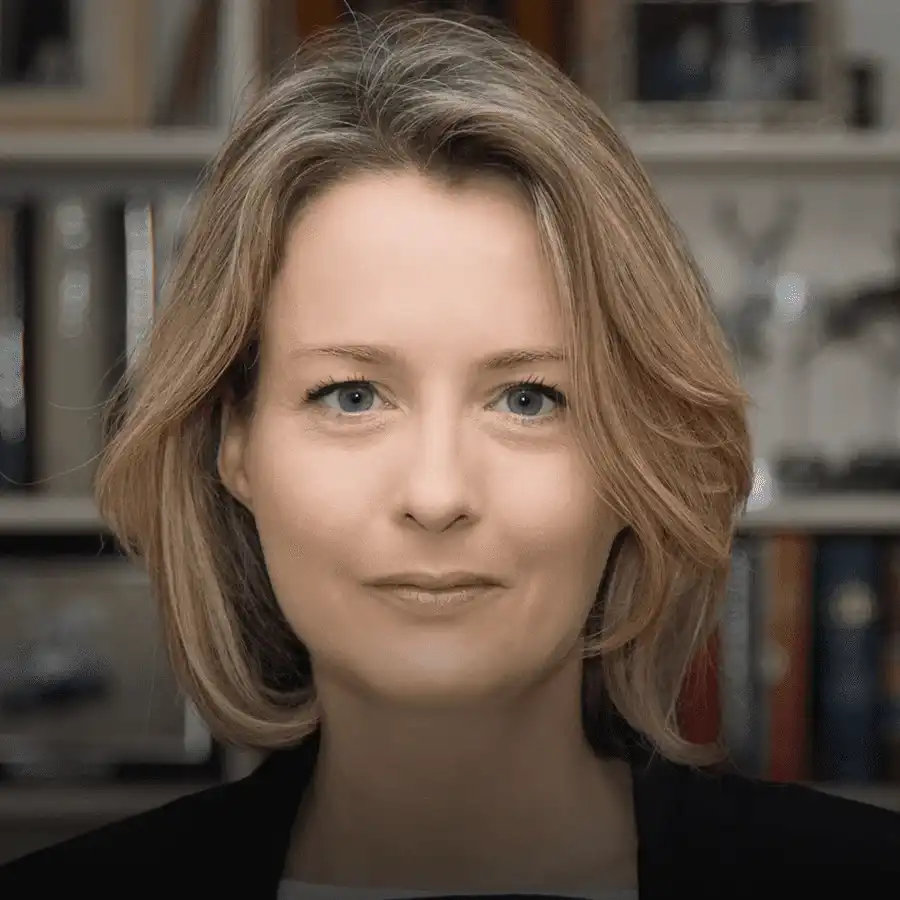
This one runs as a masterclass: Anna Machin takes your colleagues through the research and the thinking behind it, with live questions throughout.
The answer to the question of what love is has taxed us from the moment we came to consciousness. What is this phenomenon which we all share but is, at the same time, so personal? Which is capable of inducing incomparable euphoria but can at the same time take us to the depths of despair?
In this inspiration session, evolutionary anthropologist Dr. Anna Machin uses cutting edge science to lead the audience on a journey through the science of love.
During the expert session, Dr. Machin engages the audience through methods like Q&A sessions using the Mentimeter app and sharing insights into the complexities of love and its neurochemical underpinnings.
She encourages active participation by asking for opinions on various topics related to love and relationships, allowing for a rich and interactive learning experience.
Additionally, she employs real-time polls with the Mentimeter app to gather audience perspectives and facilitate a meaningful discussion on lesser-explored aspects of love.
Gain insights into the neurochemical underpinnings of love through an exploration of oxytocin, dopamine, serotonin, and beta-endorphin - the "love hormones" that significantly impact our experiences and behaviors in relationships.
Understand how attachment relationships during childhood shape our psychological and emotional development, influencing our attachments throughout life. Learn about the four attachment profiles based on high or low anxiety and proximity.
Discover ways to rekindle long-term relationships by releasing endorphins through activities like massage, touch, laughter, dancing, and doing something new. Explore potential ethical concerns surrounding the development of drugs for love and relationship pain.
In this expert session, Dr. Anna Machin delves into the intricacies of love from a neuroscientific perspective, discussing the role of various neurochemicals in shaping our experiences and behaviors within relationships.
Beginning with oxytocin, known as the "love hormone," she explains how this neuropeptide plays an integral part in lowering inhibitions, boosting self-esteem, and increasing confidence during new relationships. In conjunction with dopamine, it enhances learning and memory processes, providing a sense of reward and pleasure that motivates individuals to pursue new connections.
Next, the speaker discusses dopamine's role as the "hormone of motivation," working synergistically with oxytocin to encourage approaching potential partners and initiating interactions. Moving on, she explores serotonin's function in the more obsessive aspects of love, suggesting that its decrease during the start of a relationship could explain the intense focus and infatuation individuals experience.
Lastly, Dr. Machin introduces beta-endorphin, which functions as an opiate to create a strong addiction and acts as the primary motivator for maintaining long-term relationships once the initial stages have passed.
The session further delves into the importance of understanding attachment relationships, exploring their role in shaping psychological and emotional development, particularly during childhood. Dr. Machin explains how these relationships are characterized by proximity cravings, reliance upon each other, and intense separation distress when separated.
She also touches on various attachment profiles based on high or low anxiety and proximity levels.
Throughout the session, Dr. Machin highlights the complex role of genetics in various aspects of love and relationships, including pair bond formation, oxytocin receptivity, empathy, attachment styles, and serotonin levels.
She also discusses the concept of differential susceptibility, emphasizing how genes interact with the environment to shape individual responses and experiences.
As the session progresses, Dr. Machin acknowledges the challenges presented by online interactions and digital images in accurately assessing potential partners or determining truthfulness. She suggests that strong initial attraction and neurochemicals are harder to experience at a distance.
Additionally, she offers suggestions for rekindling relationships through activities like massage, touch, laughter, dancing, and doing something new.
Furthermore, the speaker briefly touches upon ethical concerns surrounding potential applications of this research, such as developing love drugs based on neurochemical findings or reducing the pain of breakups by erasing memories of past relationships. She also explores the complexities of polyamory and its implications for brain function and cognitive activation in managing multiple relationships.
Dr. Machin emphasizes respecting individuals' definitions of love and acknowledges the subjective nature of this fundamental human emotion. Throughout the session, she encourages audience participation through the Mentimeter app to foster deeper engagement and learning.
As the hour comes to a close, she expresses her gratitude for their questions and insights, wishing them a great day or evening before looking forward to connecting with them again soon.
It is interactive, and the block above says exactly how for this session. Nobody has to speak up who does not want to: the chat and the polls carry most of it, and the questions can come in anonymously.
The answer to the question of what love is has taxed us from the moment we came to consciousness. What is this phenomenon which we all share but is, at the same time, so personal? It is built for a general working audience: no prior knowledge is assumed, and people who already know the subject get the research and the practical side rather than an introduction.
A masterclass. Anna Machin takes your colleagues through the subject and the reasoning behind it, and answers live questions. It is practical in what people take away, without the hour turning into an exercise class.
It runs 45 min / 15 min: the talk, then live questions. All you do is pick a date. We brief Anna, produce the session, host and moderate it, run the Q&A, and send you the report within an hour of the end.
A team, a department, an employee network or every single employee at once, with no cap and no per-seat price. It runs inside your own Microsoft Teams, Zoom or Google Meet, or on a branded page we build. No integration, no login, no company device or e-mail.
The session is delivered in English. You can add high accuracy live subtitles in 8, 16 or 24 languages, so everyone follows in their own. That is a paid option, priced by the number of languages you need.
No, and that is by design. There is nothing to install, nothing to integrate and no connection to your systems, so there is nothing for IT to validate: we join your own Teams, Zoom or Meet as a guest speaker, or we host a page and your people open a link. No software, no accounts, and no data of yours that we can reach. It is why hundreds of companies, among them some of the largest technology and financial firms in the world, were able to start within a day.
We never receive or hold personal data about your employees. Because the session runs in your own environment, attendance and identity stay with you, and what we report back is aggregated: numbers, ratings and survey answers, not people. That is also why IT approval usually takes minutes rather than weeks.
You keep the recording and can share it internally. You also get attendance over time, participant ratings for the content and the speaker, the survey answers, and the topics your people asked for next.

"People will forget what you said... but people will never forget how you made them feel," - Maya Angelou This hands-on workshop…
In a few interactive, playful exercises Rod shows people how to switch from ‘Yes, but’ to ‘Yes, and’.
In this 60 minute interactive session, Rod makes the case that the success or failure of everything we do depends on only one…

(Dutch Only) Irene shows how creativity and choosing a different perspective can have a huge impact.

As the world settles back into some form of this new normal, you may have noticed something is missing.
We say we want creativity but we build systems for speed, predictability, and control.