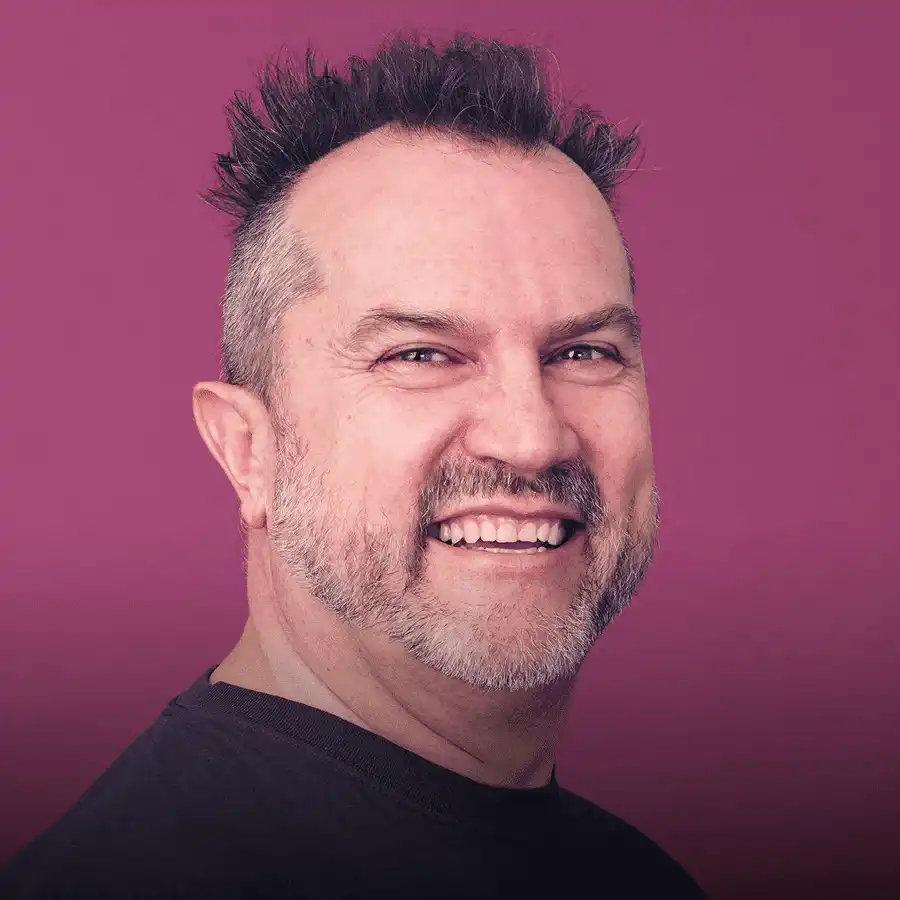
This one runs as an interactive workshop: the hour includes exercises your colleagues do themselves, not only a talk.
We say we want creativity but we build systems for speed, predictability, and control. Then we blame people when good ideas don’t show up.
Teams and organisations are struggling to adapt fast enough to how technology is reshaping our world. Creativity gives us the capacity to observe, analyse, project, ideate and adapt, thereby dealing better with change and producing new answers the questions.
This talk challenges one of the most persistent myths of our time: that creativity is a personal trait.
It isn’t.
Creativity is the result of a system and most of us are operating inside systems that are perfectly designed to suppress it.
During Creating Work Creativity you will discover what is standing in the way of creativity at work, and what’s needed to tweak your system and overcome it.
In his session, David lets participants actively participate to spark their creativity. By scanning a QR code, he gives commands to the audience and we see the results back on the screen.
To enhance your creative thinking, find moments of mental quiet free from stress and multitasking, focus inward on your thoughts and feelings, and maintain a positive mood.
Create an inspiring work environment with focus spaces, privacy, psychological safety, diversity, and open-mindedness to encourage creative problem-solving and innovation.
Recognize that creativity is not limited to traditional artistic pursuits; everyday activities like having ideas or solving problems are creative acts, so make time for these moments and embrace your unique level of creativity.
In this expert session, David Chislett explores the conditions necessary to cultivate a creative mindset. He explains that mental quiet is essential for creativity, emphasizing the need for a calm mind free from stress, worry, and multitasking.
He also highlights the importance of being inward-looking, focusing on one's feelings, thoughts, and instincts without external influences.
Maintaining a positive mood is another key point David discusses. He notes that a slight sense of happiness can enhance creative thinking and suggests entering a state of optimal experience, known as flow, where one uses their skills at the edge of their capabilities without trying too hard.
David shares common places where creativity often emerges, such as during showering, transitions between sleep and wakefulness, watching TV, and engaging in mundane physical activities like walking or cycling. He offers tips for boosting creativity at work, including releasing judgment, practicing brainstorming techniques, taking breaks, collaborating with others, and creating a stimulating environment.
He encourages the audience to share their thoughts on where they typically experience creativity, prompting a discussion about various scenarios like running, sleeping, watching TV, meetings, and work. David emphasizes the importance of releasing judgment to make room for new ideas and encourages creativity even in daily work tasks.
David stresses the need for focused spaces, privacy, psychological safety, diversity, and open-mindedness within teams and organizations to enhance creative thinking and productivity. He introduces the concept of the "beginner's mind" and suggests using a Rebel-Reject-Create Matrix to encourage creativity by challenging external rules and internal assumptions.
He encourages businesses to create an inclusive and diverse work environment that fosters creativity and innovation. He believes that humans have an inherent capacity for creativity, which is essential for problem-solving and generating innovative ideas.
However, he acknowledges that societal pressures and external agendas can sometimes prevent individuals from accessing their creative potential.
To tap into one's creativity, David advises observing oneself and noting the times when creativity flows most freely. He also emphasizes making time for creative activities throughout the day, as this practice will gradually become less effortful.
When addressing a question about planning creativity, David acknowledges that setting aside time for creative work can be beneficial but advises against feeling pressured to be creative at a specific moment if inspiration isn’t present. Instead, he suggests taking short breaks and disengaging from current tasks to help spark new ideas.
David recognizes the challenge of integrating creativity into rigid work systems that prioritize deliverables and KPIs. He recommends having conversations with team leaders or management to create space for experimentation, encourage innovation, and accept the possibility of failure.
He believes that inflexible KPIs may not bring out the best in individuals in an ever-changing world. The session concludes with David thanking everyone for their attention and participation, encouraging those with remaining questions to write them down or ask during future sessions.
From the survey every participant gets when the session ends, in their own words.
How to incentive creativity in ourselves. Love the energy! Thanks for that..
Love the energy. Well done!
It was helpful, thank you!
That there are no creative people, only people that are more used to unleash their creativity than others. That you can't force creativity, only set up a good environment for it
The moderator was not good. She did not pick up many comments and ideas provided by different people in the chat
I really appreciated the topic and also the speaker was really good
The books which were mentioned in this session was a good idea.
It is interactive, and the block above says exactly how for this session. Nobody has to speak up who does not want to: the chat and the polls carry most of it, and the questions can come in anonymously.
We say we want creativity but we build systems for speed, predictability, and control. Then we blame people when good ideas don’t show up. It is built for a general working audience: no prior knowledge is assumed, and people who already know the subject get the research and the practical side rather than an introduction.
A workshop. The description of this session says so itself: the hour includes exercises and activities that participants do, not only an expert speaking. It still runs live and online, for as many colleagues as you want to invite.
David Chislett is one of the experts we auditioned ourselves, and we produce every session so we see how each one lands. Participants rate this session 4.1 out of 5, across 54 responses, and rate David personally 4.5 out of 5.
It runs 45 min / 15 min: the talk, then live questions. All you do is pick a date. We brief David, produce the session, host and moderate it, run the Q&A, and send you the report within an hour of the end.
A team, a department, an employee network or every single employee at once, with no cap and no per-seat price. It runs inside your own Microsoft Teams, Zoom or Google Meet, or on a branded page we build. No integration, no login, no company device or e-mail.
The session is delivered in English. You can add high accuracy live subtitles in 8, 16 or 24 languages, so everyone follows in their own. That is a paid option, priced by the number of languages you need.
No, and that is by design. There is nothing to install, nothing to integrate and no connection to your systems, so there is nothing for IT to validate: we join your own Teams, Zoom or Meet as a guest speaker, or we host a page and your people open a link. No software, no accounts, and no data of yours that we can reach. It is why hundreds of companies, among them some of the largest technology and financial firms in the world, were able to start within a day.
We never receive or hold personal data about your employees. Because the session runs in your own environment, attendance and identity stay with you, and what we report back is aggregated: numbers, ratings and survey answers, not people. That is also why IT approval usually takes minutes rather than weeks.
You keep the recording and can share it internally. You also get attendance over time, participant ratings for the content and the speaker, the survey answers, and the topics your people asked for next.

"People will forget what you said... but people will never forget how you made them feel," - Maya Angelou This hands-on workshop…
In a few interactive, playful exercises Rod shows people how to switch from ‘Yes, but’ to ‘Yes, and’.
In this 60 minute interactive session, Rod makes the case that the success or failure of everything we do depends on only one…

(Dutch Only) Irene shows how creativity and choosing a different perspective can have a huge impact.

As the world settles back into some form of this new normal, you may have noticed something is missing.
Creativity is often misunderstood as a rare talent reserved for artists, while in reality it is a practical and learnable skill…