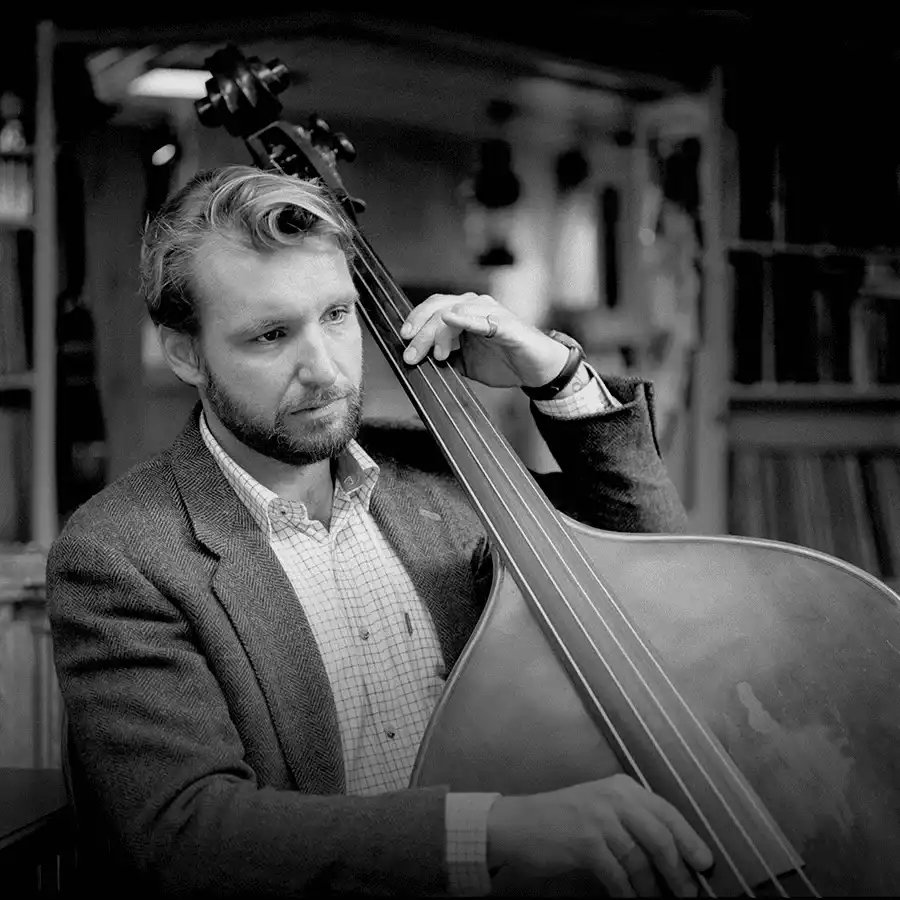
This one runs as a masterclass: Artur Jaschke takes your colleagues through the research and the thinking behind it, with live questions throughout.
Most people would say they enjoy listening to (certain types of) music. But what do we actually know about what music does to us? Music touches us quite literally and provides us with and elegant insight into brain development, cognition, behaviour and emotion and how this transfers to creativity and experiencing the world around us.
How does the brain process, perceive and produce music and how can this be used in everyday life? In this scientific inspiration session, we will explore and learn about the influence of music on our brain and in turn our ability to improvise.
During the expert session, Artur engages the audience through a Q&A session, demonstrations of music's impact on different brain regions using examples from various musical genres, and interactive exercises with the Mentimeter app to explore personal musical preferences and associations. These activities help participants understand the role of attention and engagement in music, appreciate its diverse effects on the brain, and discover new musical experiences.
Understanding how musical training activates various brain regions and improves cognitive functions, such as patience, focus, memory, language development, and mathematical abilities, is essential for appreciating its far-reaching benefits.
Embracing different music genres can lead to greater brain stimulation by engaging distinct areas of the brain and nervous system. Being open-minded and challenging oneself to try new styles can result in significant cognitive benefits.
Familiar sounds or jingles in music can be strongly linked to specific feelings or actions through repetition and exposure, making them powerful tools for marketing campaigns and highlighting the importance of neurlinguistic programming.
In this expert session, Artur Jaschke delved into the intricacies of the human brain's relationship with music, emotions, memories, and the body. He began by introducing the audience to the complex network of regions in the brain, including the frontal, parietal, temporal, and occipital lobes, which work together to process information from different senses and create connections between the brain and the body.
Artur also explored the idea of active versus passive listening, using a restaurant setting as an example, where recognizing a familiar song is a deliberate choice made by the brain. He highlighted the importance of understanding that the brain and body are interconnected and both essential for cognitive functions.
Furthermore, he emphasized the long developmental process of the human brain, with the frontal lobe maturing around age 30, and the significance of providing opportunities to stimulate brain development through various experiences and interests.
One research study Artur discussed investigated the impact of structured arts and music education on children's cognitive functions. The study involved 230 children divided into four groups: muziek, muziek plus, visual arts, and no arts control.
While all groups continued to receive some exposure to arts and music in their regular school curriculum, researchers found that the muziek plus group showed significant improvements in inhibition, planning, working memory, and visuospatial working memory after one year compared to the other groups. These findings suggest that providing children with structured arts and music education can lead to essential skill development for everyday life.
Artur further discussed the far transfer effect of musical training, which extends beyond the domain of music itself, improving patience, focus, memory, language development, and mathematical abilities. He also shared insights into comparative studies in other fields like martial arts and chess, noting their unique benefits but emphasizing music's advantageous effects on cognitive development through far transfer.
Addressing a question from the audience, Artur acknowledged that the three years of active music engagement can indeed lead to significant improvements in various areas related to music training and beyond. However, he also reminded us that these improvements depend on individual commitment and engagement with the activity.
Moreover, Artur touched upon the perception of music as a luxury and explored cultural differences in how music is perceived and approached.
In conclusion, Artur Jaschke's expert session provided valuable insights into the complex relationship between music, emotions, memories, the brain, and the body, emphasizing their intricacies and the importance of understanding the whole system rather than individual components. The findings from the research discussed in the session suggest that providing opportunities for structured arts and music education can lead to essential cognitive skill development for children, making it a worthwhile investment.
From the survey every participant gets when the session ends, in their own words.
Great session. Really inspiring. Thanks and congratulations to Antonia and to the HR team for this session.
Really engaging and informative session - thank you so much Antonia for your time and passion.
This was a very interesting talk, thanks for hosting it.
Ben dagelijks met muziek bezig en weet globaal wat muziek voor een mens kan betekenen. Leuk dit nog eens duidelijk uitgelegd te krijgen.
It is interactive, and the block above says exactly how for this session. Nobody has to speak up who does not want to: the chat and the polls carry most of it, and the questions can come in anonymously.
Most people would say they enjoy listening to (certain types of) music. But what do we actually know about what music does to us? It is built for a general working audience: no prior knowledge is assumed, and people who already know the subject get the research and the practical side rather than an introduction.
A masterclass. Artur Jaschke takes your colleagues through the subject and the reasoning behind it, and answers live questions. It is practical in what people take away, without the hour turning into an exercise class.
Artur Jaschke is one of the experts we auditioned ourselves, and we produce every session so we see how each one lands. Participants rate this session 3.8 out of 5, across 43 responses, and rate Artur personally 4.1 out of 5.
It runs 45 min / 15 min: the talk, then live questions. All you do is pick a date. We brief Artur, produce the session, host and moderate it, run the Q&A, and send you the report within an hour of the end.
A team, a department, an employee network or every single employee at once, with no cap and no per-seat price. It runs inside your own Microsoft Teams, Zoom or Google Meet, or on a branded page we build. No integration, no login, no company device or e-mail.
The session is delivered in English, Dutch. You can add high accuracy live subtitles in 8, 16 or 24 languages, so everyone follows in their own. That is a paid option, priced by the number of languages you need.
No, and that is by design. There is nothing to install, nothing to integrate and no connection to your systems, so there is nothing for IT to validate: we join your own Teams, Zoom or Meet as a guest speaker, or we host a page and your people open a link. No software, no accounts, and no data of yours that we can reach. It is why hundreds of companies, among them some of the largest technology and financial firms in the world, were able to start within a day.
We never receive or hold personal data about your employees. Because the session runs in your own environment, attendance and identity stay with you, and what we report back is aggregated: numbers, ratings and survey answers, not people. That is also why IT approval usually takes minutes rather than weeks.
You keep the recording and can share it internally. You also get attendance over time, participant ratings for the content and the speaker, the survey answers, and the topics your people asked for next.
"People will forget what you said... but people will never forget how you made them feel," - Maya Angelou This hands-on workshop…
In a few interactive, playful exercises Rod shows people how to switch from ‘Yes, but’ to ‘Yes, and’.
In this 60 minute interactive session, Rod makes the case that the success or failure of everything we do depends on only one…

Despite constant warnings, we are reluctant to change our ways when it comes to accumulating more and more things.
Kilian gives an intriguing leqture on the effect of money and other incentives to reward behaviour.
Da Vinci is known for being an inventor and an artist, but most of all, he was an excellent observer.