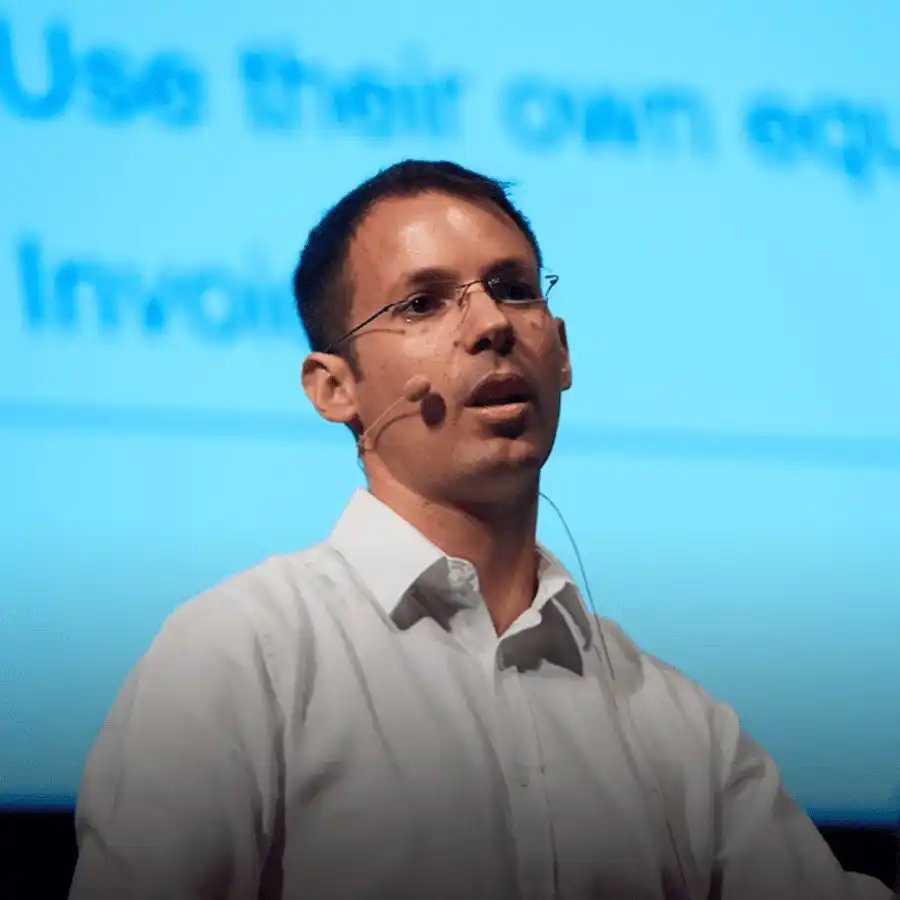
Assaf has worked at one of the top law firms in Israel, specialising in commercial law, venture capital funds, Internet & Computer law and Start-Ups. In 2014, Assaf established the IDC Legal Clinic for Start-ups, and has since been teaching courses such as “Entrepreneurship 101” and “International Business Negotiations” at numerous leading universities, including the IDC (Israel), Technion (Israel), Innsbruck (Austria), and Peking (China). Assaf was awarded a certificate of excellence in teaching. Additionally, he serves as an advisor and mentor to startups around the world and is a leading advisor on startups.com.
All sessions by Assaf →Mistakes cost time and money, and can have a devastating effect on a startup or business venture. During this leqture, and with the help of some real-life stories and humor, you will discover the 3 most common business/legal mistakes made by entrepreneurs and intrapreneurs - and how to overcome them.
The result: you will have eaten from the ‘forbidden fruit’, and gained the knowledge needed to avoid these mistakes, and perhaps even be able to guide your friends so that they too can avoid them. Join Assaf in this session and learn how to avoid the common mistakes made by startup founders.
During the expert session, Assaf Ben David engages the audience in a thoughtful discussion on common mistakes made by startup founders. Using personal anecdotes and valuable insights, he encourages entrepreneurs to learn from past experiences and be open to feedback.
Assaf introduces interactive elements, including a Q&A session, live polling via Mentimeter app, and group discussions, enabling the audience to share their thoughts and ask questions. These activities inspire participants to reflect on their own entrepreneurial journeys and apply Assaf's lessons to their businesses.
Identifying genuine pain points in the market and addressing them is essential for successful product development. This can be achieved by asking 'why' questions, reflecting on daily frustrations, and listening to others.
Learning from negative feedback is crucial for growth and improvement in entrepreneurship. Embracing a mindset of continuous learning and adaptation allows entrepreneurs to pivot their ideas and find better solutions.
Adopting the lean methodology encourages startups to fail fast with minimal resources, allowing them to learn from their mistakes and adapt quickly for future success.
In this expert session, Assaf Ben David shares valuable insights on common mistakes made by startup founders based on his personal experience of creating an online marketplace for last-minute ticket sales. Assaf begins by recounting his late Friday night realization that led him to the idea for the platform but emphasizes the importance of identifying market need before developing a product or idea.
One of the primary mistakes Assaf made was the lack of a formal agreement with his friend, who built the website. He didn't establish clear terms for payment or ownership, which could have led to potential disputes.
Another mistake was ignoring advice from others and not seeking input from experts or potential customers before building the website.
Assaf also mentions the importance of effective design and branding, as his platform had a basic layout and lacked user experience features. He didn't consider potential trademark or copyright infringement with other companies and failed to apply for patents on his idea.
Furthermore, Assaf admits to not conducting thorough market research, which may have helped him identify competition in the industry and potential demand for the service.
Another mistake was overconfidence in the success of the website, which led him to ignore potential warning signs or criticism. As a student with limited resources and time, Assaf also found it challenging to devote adequate effort to marketing his platform effectively.
To avoid these mistakes in future business endeavors, Assaf encourages entrepreneurs to seek advice from experts, conduct thorough market research, create formal agreements, focus on effective design and branding, and remain open to constructive criticism. He emphasizes the importance of understanding why people may have negative perceptions about an idea and whether it's based on fear or a real need.
Assaf also encourages entrepreneurs to pivot or adapt their ideas to address different needs or problems. He emphasizes the importance of being open-minded yet confident in one's vision, as well as continuously improving to provide value to users.
The expert session concludes with Assaf expressing gratitude towards the participants for their engagement and encouraging them to ask questions if they have any.
The session also includes a presentation on creating user-friendly experiences, gathering feedback, and continuously improving. Assaf emphasizes the importance of falling in love with the problem instead of an idea, sharing ideas with others, and being open to criticism and feedback.
The session ends with Assaf answering questions about finding problems to solve and embracing failure in startups, encouraging entrepreneurs to adopt the lean methodology and learn from their failures.
No prior knowledge is assumed. It is built for a general working audience, and people who already know the subject get the research and the practical side rather than an introduction. What the hour itself covers: Mistakes cost time and money, and can have a devastating effect on a startup or business venture. During this leqture, and with the help of some real-life stories and humor, you will discover the 3 most common business/legal mistakes made by entrepreneurs and intrapreneurs - and how to overcome them.
It is interactive, and the block higher up on this page says exactly how for this session. Nobody has to speak up who does not want to: the chat and the polls carry most of it, and the questions can come in anonymously.
It runs 45 min / 15 min: the talk, then live questions. All you do is pick a date. We brief Assaf, produce the session, host and moderate it, run the Q&A, and send you the report within an hour of the end.
A team, a department, an employee network or every single employee at once, with no cap and no per-seat price. It runs inside your own Microsoft Teams, Zoom or Google Meet, or on a branded page we build. No integration, no login, no company device or e-mail.
The session is delivered in English, Dutch. You can add high accuracy live subtitles in 8, 16 or 24 languages, so everyone follows in their own. That is a paid option, priced by the number of languages you need.
No, and that is by design. There is nothing to install, nothing to integrate and no connection to your systems, so there is nothing for IT to validate: we join your own Teams, Zoom or Meet as a guest speaker, or we host a page and your people open a link. No software, no accounts, and no data of yours that we can reach. It is why hundreds of companies, among them some of the largest technology and financial firms in the world, were able to start within a day.
We never receive or hold personal data about your employees. Because the session runs in your own environment, attendance and identity stay with you, and what we report back is aggregated: numbers, ratings and survey answers, not people. That is also why IT approval usually takes minutes rather than weeks.
You keep the recording and can share it internally. You also get attendance over time, participant ratings for the content and the speaker, the survey answers, and the topics your people asked for next.
Kilian gives an intriguing leqture on the effect of money and other incentives to reward behaviour.

In this lively and evidence-based session, behavioral psychologist Dr. Florien Cramwinckel reveals how small money hacks can…

When is an act considered as money laundering? Joras provides insights into this criminal activity.
Negotiation is everywhere and negotiation is part of our lives. In this interactive leqture, Eduard will explain why negotiations…

Non Fungible Tokens (NFTs) are 'talk of the town'. Artists, investors, big brands, developers; they are all joining the rapidly…

Many associate innovation with breakthrough technologies or major industry disruptions, but innovation starts with leadership and…