Reframing: The Art of Thinking Differently
Karim Benammar
Book a demo →from €2,250 for your whole company
Book a demo →from €2,250 for your whole company
This one runs as a masterclass: Karim Benammar takes your colleagues through the research and the thinking behind it, with live questions throughout.
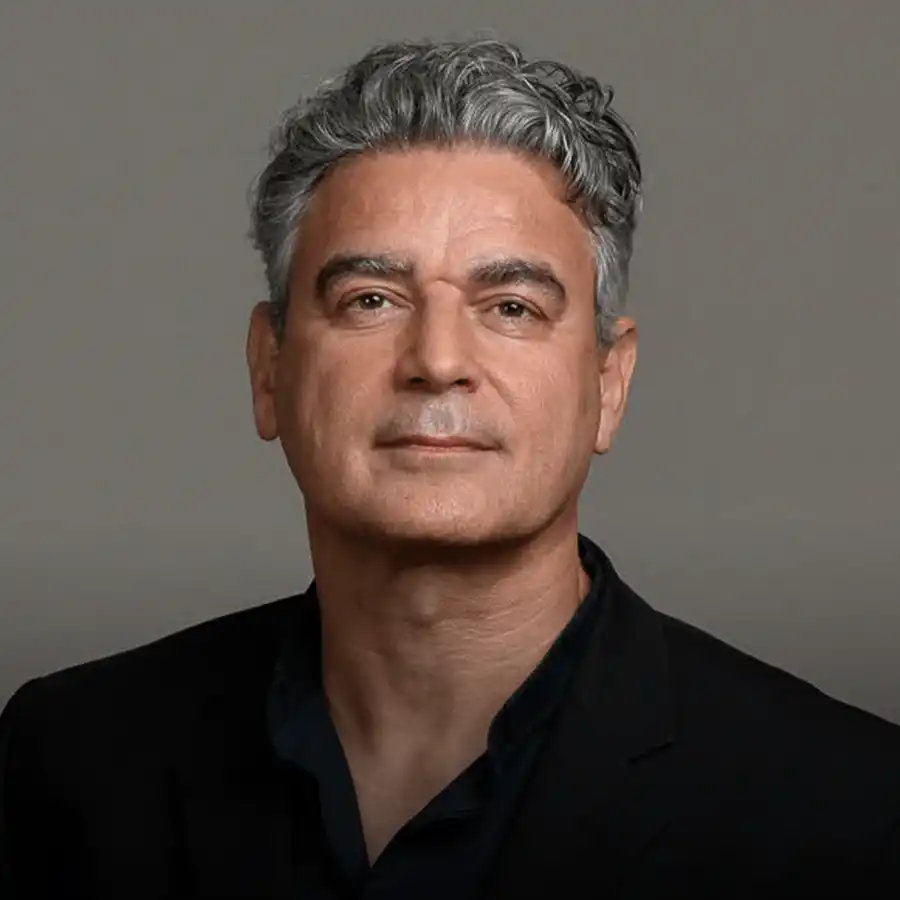
Karim Benammar, PhD , is a philosopher specialising in transformative thinking. He gives lectures and workshops for companies and organisations. Benammar studied philosophy in England, the United States and Japan, taught at Kobe University and directed research at Amsterdam University of Applied Sciences. He is the author of Abundance (2005) and Reframing – The Art of Thinking Differently (2012).
All sessions by Karim →Are you able to challenge your own assumptions? Sometimes a radically different view can offer new possibilities and insights. For example, can you always rely on data? Do we really need to produce this report?
Is the customer always right? Is input really the same as output? Is this model the only way to make things work in our company or industry? All our socio-economic systems are based on assumptions. In this interactive session, Karim teaches your team to look at issues differently in order to come up with completely new solutions.
This is an interactive session in which Karim puts several questions to the audience. Every participant has the chance to reflect on their own assumptions, to question them, to change them, and to design a way to experiment with them. Q&A at the end.
Reframing limiting beliefs . Recognizing and challenging outdated assumptions is crucial for adapting to new realities and driving innovation. Questioning our fundamental assumptions and creating radical alternatives takes us out of our limiting framework.
Developing a wide variety of perspectives . We tend to have a preference in our approach, a default position from which we work. This session encourages participants to develop a wide variety of perspectives, so that we have the flexibility to treat each situation in the way it requires.
Taking the initiative . We only change our behavior when we decide to do things differently. When we do things differently, the system around us will have to adapt. This is an empowering shift: from a reactive sense of having no agency to the desire to experiment with new approaches.
Much of the way we see the world is simply incorrect. Dinosaurs did not look the way we think they did. The lion is not the king of the jungle. The world map we use every day is dramatically distorted and gives us a completely wrong idea of the world.
Karim opens the session with these wrong pictures and shows why they survive: we keep repeating old views instead of updating them to what we now know.
The same is true of many assumptions in our professional lives, about clients, about communication, about pricing, about the way we run meetings and answer email. In our first interaction, participants examine their own way of working.
What assumptions underlie their current approach, and are they still correct? Our assumptions work like a set of glasses: they determine what we see and what we miss. Most of us have a favorite pair. The aim of the session is flexibility, a whole collection of glasses, so that we can choose the perspective that fits the situation instead of the one we have always worn. This is our personal challenge and growth opportunity.
We examine examples of radically different approaches that led to dramatic breakthroughs in science, sports, and business, and analyze how to shift our thinking in a similar way. Participants come up with radically new assumptions, and with a different perspective in hand, they design a small experiment.
We use A/B testing as a method: A is what we normally do, B is the new approach. It takes courage to try something new, so we try the smallest possible experiment, and the experiment is successful whatever happens, because it gives us data about whether this is a better approach.
While these are serious issues, it is an engaging and fun session. When we realize how much of our view of the world rests on wrong assumptions, we understand how much there is to gain from looking at things in a new way: opportunities to improve our impact, our effectiveness, and our work.
It feels like a liberation from the limiting beliefs we started off with, and we leave with a commitment to try something new.
From the survey every participant gets when the session ends, in their own words.
I learned how powerful it is to change your perspective. Amazing lecture - truly loved it!
Out of the box thinking is so excellent and it is a good reminder for me what I have been taught many years ago. I forgot how important it is. Compliment also for the host, well done. Thank you.
Really loved the speaker, very inspirational. More people should join this talk & practice
It was absolutely amazing :)
It was a very interesting lecture. I really enjoyed the examples of how a different view on something existing can lead to enormous positive breakthroughs. Thanks!
Thank You for that good presentation with great content. I would still love more of that really good examples.
One of the best speakers ever. Great and highly interesting topic, lots of useful tips and interesting ideas to think about going forward. Highly recommend this session for everyone. Please invite him again in the future.
Very very interesting session ! Thank you very much Dr. Karim Benammar, a very professionnal and inspired man ! And thank you Bobby for the moderation ;) See you on the 13th of december, with pleasure :)
No prior knowledge is assumed. It is built for a general working audience, and people who already know the subject get the research and the practical side rather than an introduction. What the hour itself covers: Are you able to challenge your own assumptions? Sometimes a radically different view can offer new possibilities and insights.
A masterclass. Karim Benammar takes your colleagues through the subject and the reasoning behind it, and answers live questions. It is practical in what people take away, without the hour turning into an exercise class.
Karim Benammar is one of the experts we auditioned ourselves, and we produce every session so we see how each one lands. Participants rate this session 4.3 out of 5, across 2,305 responses, and rate Karim personally 4.5 out of 5.
It is interactive, and the block higher up on this page says exactly how for this session. Nobody has to speak up who does not want to: the chat and the polls carry most of it, and the questions can come in anonymously.
It runs 45 min / 15 min: the talk, then live questions. All you do is pick a date. We brief Karim, produce the session, host and moderate it, run the Q&A, and send you the report within an hour of the end.
A team, a department, an employee network or every single employee at once, with no cap and no per-seat price. It runs inside your own Microsoft Teams, Zoom or Google Meet, or on a branded page we build. No integration, no login, no company device or e-mail.
The session is delivered in English, Dutch. You can add high accuracy live subtitles in 8, 16 or 24 languages, so everyone follows in their own. That is a paid option, priced by the number of languages you need.
No, and that is by design. There is nothing to install, nothing to integrate and no connection to your systems, so there is nothing for IT to validate: we join your own Teams, Zoom or Meet as a guest speaker, or we host a page and your people open a link. No software, no accounts, and no data of yours that we can reach. It is why hundreds of companies, among them some of the largest technology and financial firms in the world, were able to start within a day.
We never receive or hold personal data about your employees. Because the session runs in your own environment, attendance and identity stay with you, and what we report back is aggregated: numbers, ratings and survey answers, not people. That is also why IT approval usually takes minutes rather than weeks.
You keep the recording and can share it internally. You also get attendance over time, participant ratings for the content and the speaker, the survey answers, and the topics your people asked for next.
What are your thoughts and emotions about climate change? For most people it is a sense of being overwhelmed by the size and…
Almost everyone is confused about AI, because of the many conflicting claims about it and the speed at which it keeps changing.