

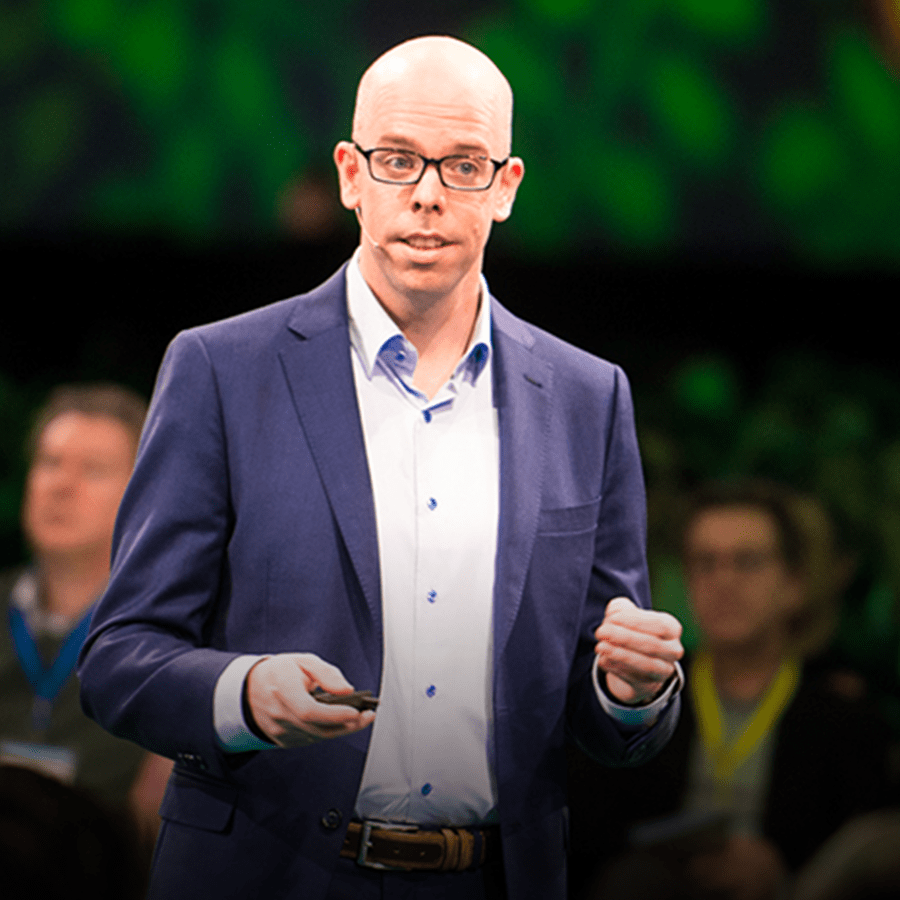
Jan Scheele organized 50 TED events worldwide and ended up in blockchain technology in 2015. Besides being CEO of a blockchain scaleup ($18 million investment) and advisor at a blockchain boutique, he is Digital Leader at the World Economic Forum and board member at the Blockchain Netherlands Foundation. He speaks globally about blockchain technology and the different facets of the technology, such as NFTs, DeFi, Metaverse and CBDCs. Jan has worked for tens of organisations such as Google, Accenture and the Dutch National Police.
All sessions by Jan →Virtual worlds have been around for a while, but with the name change of the parent company from Facebook to “Meta” the concept of 'metaverse' got suddenly a lot of attention. Metaverse is the future virtual world that ties together all other pre-existing virtual worlds.
This changes the current 'flat' 2D worldwide web to a three-dimensional world. We see countless organizations getting started with this, attracting tens of millions of visitors to their virtual establishment in the metaverse.
But where does the metaverse actually come from? What kind of special applications do we already see worldwide in the most diverse sectors? What is 'big tech' planning to work on and how are governments responding?
What are the developments in the short and long term? In this Leqture, Jan Scheele takes you on a virtual journey through the wonderful world of the metaverse.
During the expert session, Jan Scheele engages the audience through a Q&A session, live demonstrations of metaverse applications, and an interactive exercise using the Mentimeter app to explore virtual currencies and NFTs within the metaverse. These activities provide insights into the potential challenges and opportunities in the metaverse, including privacy, security, regulation, capacity, and striking a balance between virtual and physical life.
Jan emphasizes the need for individual responsibility, time management, and the involvement of various technologies like IoT and AI. The session concludes with a look at exciting advancements in the metaverse, such as touch, smell, and taste experiences, and an invitation to participate in further exploration through a survey linked in the chat.
The metaverse offers a vast potential for businesses, from virtual production planning and sales to entertainment and socializing. Companies like Hundai, Walmart, and Alibaba are already leading the way, but the possibilities are endless.
As we delve deeper into the metaverse, it's essential to maintain a balance between virtual and physical life. This includes managing time effectively, being responsible for our actions in a digital world, and considering the environmental impact.
The metaverse will introduce new economies centered around virtual currencies, NFTs, and digital assets. Governments are taking steps to regulate these areas, but it's crucial to stay informed about this rapidly evolving landscape.
In this expert session, Jan Scheele explores the latest trends and developments in the Metaverse, focusing on its economic potential and impact on various industries. Jan begins by highlighting the significant growth of the gaming industry, with over three billion active gamers worldwide, and Americans spending an average of 16 hours per week playing virtual games. In-game purchases have become a substantial market, generating $160 billion annually.
Jan then discusses the digital transition during the COVID-19 pandemic, leading to a surge in online activity, including work, entertainment, and social interactions. He mentions that many experts predict office meetings will soon take place primarily in virtual environments.
Jan also introduces the concept of the Metaverse, an immersive virtual world where people can create, transact, and socialize.
Jan discusses various developments in the Metaverse, including virtual production planning for industries like car manufacturing and breweries. He explains how organizations are using virtual environments to plan production processes more efficiently and offer consumers customized products.
Furthermore, Jan highlights the potential of virtual B2C sales, such as Hundai's ability to let consumers design their cars virtually without any speed limit. Walmart is also using IoT data to suggest products based on consumer needs in a virtual supermarket setting.
Jan also touches upon the combination of technologies and the emergence of new economies centered around NFTs and virtual clothing. He mentions that many young people are designing their own virtual clothes and avatars on platforms like Roblox, leading to the next generation of designers and creators.
Organizations are also entering the metaverse for entertainment purposes, such as opening clubs or creating experiences for their communities.
However, Jan acknowledges the challenges and concerns surrounding privacy, security, regulation, capacity, and the balance between virtual and physical life. He mentions that there are concerns about data being shared with companies like Meta and potential misuse of technology by criminals.
The lack of regulation is also a significant concern, as is the immense capacity required for such a virtual world. Jan encourages listeners to explore the metaverse further but notes the importance of individual responsibility in managing time spent in these virtual environments.
Jan discusses virtual currencies and NFTs in the metaverse and emphasizes that there will not be a single global currency, as each metaverse uses its own token. He shares his thoughts on the regulatory landscape and notes that governments are taking action to prevent criminality and offer payment solutions.
As the session concludes, Jan answers a question about improvements in the Metaverse compared to Second Life 15 years ago. He discusses the broader applications, connections between virtual and physical worlds, and the involvement of other technologies like IoT and AI.
Jan also touches upon the topic of energy consumption, acknowledging that it varies depending on the metaverse and activities involved.
It is interactive, and the block above says exactly how for this session. Nobody has to speak up who does not want to: the chat and the polls carry most of it, and the questions can come in anonymously.
Virtual worlds have been around for a while, but with the name change of the parent company from Facebook to “Meta” the concept of 'metaverse' got suddenly a lot of attention. Metaverse is the future virtual world that ties together all other pre-existing virtual worlds. It is built for a general working audience: no prior knowledge is assumed, and people who already know the subject get the research and the practical side rather than an introduction.
Jan Scheele is one of the experts we auditioned ourselves, and we produce every session so we see how each one lands. Participants rate this session 3.8 out of 5, across 45 responses, and rate Jan personally 4.1 out of 5.
It runs 45 min / 15 min: the talk, then live questions. All you do is pick a date. We brief Jan, produce the session, host and moderate it, run the Q&A, and send you the report within an hour of the end.
A team, a department, an employee network or every single employee at once, with no cap and no per-seat price. It runs inside your own Microsoft Teams, Zoom or Google Meet, or on a branded page we build. No integration, no login, no company device or e-mail.
The session is delivered in English, Dutch. You can add high accuracy live subtitles in 8, 16 or 24 languages, so everyone follows in their own. That is a paid option, priced by the number of languages you need.
No, and that is by design. There is nothing to install, nothing to integrate and no connection to your systems, so there is nothing for IT to validate: we join your own Teams, Zoom or Meet as a guest speaker, or we host a page and your people open a link. No software, no accounts, and no data of yours that we can reach. It is why hundreds of companies, among them some of the largest technology and financial firms in the world, were able to start within a day.
We never receive or hold personal data about your employees. Because the session runs in your own environment, attendance and identity stay with you, and what we report back is aggregated: numbers, ratings and survey answers, not people. That is also why IT approval usually takes minutes rather than weeks.
You keep the recording and can share it internally. You also get attendance over time, participant ratings for the content and the speaker, the survey answers, and the topics your people asked for next.

As AI becomes part of our everyday routines, this session shows how to use generative tools (e.g., ChatGPT) to think more…

AI is transforming our lives inside and outside of the workplace - but it is only as effective as the input we give it.
We’ve all seen how generative AI can write, draw, code and create. The next big shift however isn’t about creating more content…

The World Economic Forum has called critical thinking "the one skill we all need in the age of AI”.

In China as elsewhere in the world, cybersecurity and data protection have become major topics of concern as daily life continues…
In this expert session, renowned AI researcher and thought leader Zappa discusses the current state and future implications of…