
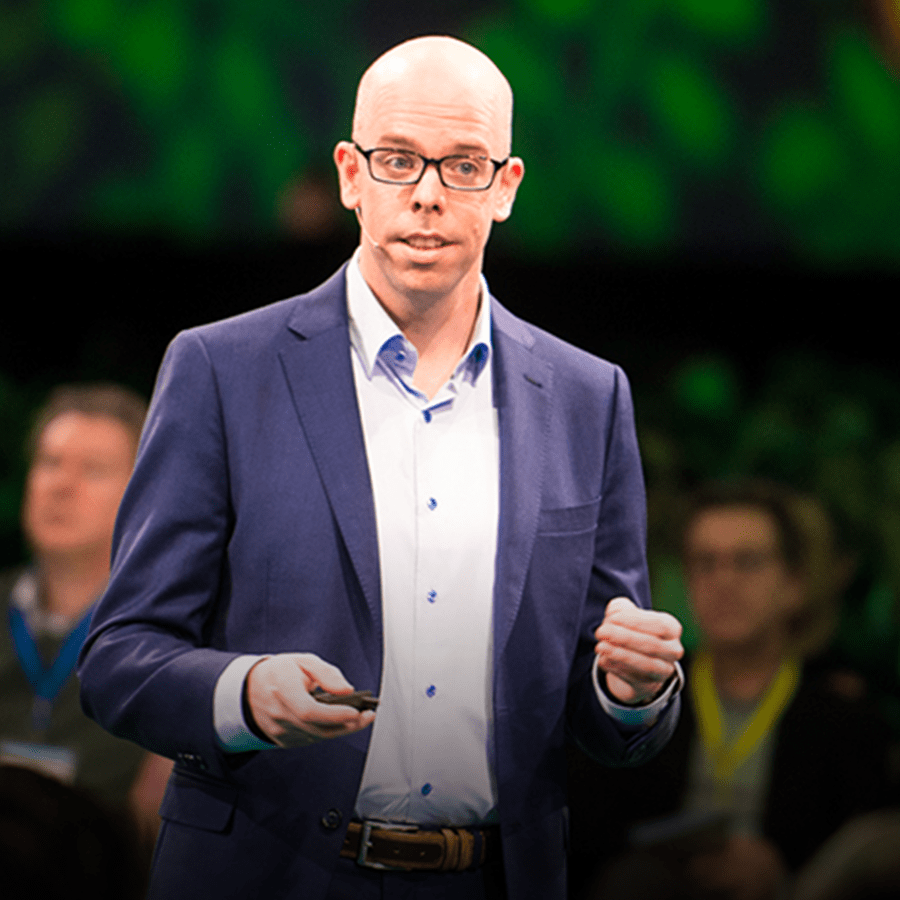
Maarten Lamers is a researcher and educator in computer science and artificial intelligence at Leiden University. His academic interests include machine learning, human-robot relations, and the question of whether machines can be creative. Explaining complex concepts through simple and engaging terms and examples, is what Maarten has specialized in. He has been called one of the most inspiring nerds of The Netherlands by a major publication, and the country’s favorite AI-explainer. His playful research was mocked by comedian Ricky Gervais – something that Maarten is proud of. Maarten holds a PhD in machine learning (2001) and is an assistant professor at Leiden University.
All sessions by Maarten →Artificial intelligence enables machines to create pictures more realistically than we can, to compose songs in mere seconds, and to write texts about any topic imaginable. But, what is AI really, why do we have it, and broadly: how does it work? And... can it be creative?
Distracted by the avalanche of news about artificial intelligence, we sometimes forget to ask the basic questions. What makes AI different from regular computing? And how does it work on the inside? These questions are the domain of computer scientists.
In this presentation, you are taken along these notions, through engaging narrative and surprising stories. Without going into technical depths, you will learn the why and how of machine learning AI, and whether it can be creative.
During the expert session, Maarten Lamers engages the audience through a live Q&A session.
No prior knowledge is assumed. It is built for a general working audience, and people who already know the subject get the research and the practical side rather than an introduction. What the hour itself covers: Artificial intelligence enables machines to create pictures more realistically than we can, to compose songs in mere seconds, and to write texts about any topic imaginable. But, what is AI really, why do we have it, and broadly: how does it work?
It is interactive, and the block higher up on this page says exactly how for this session. Nobody has to speak up who does not want to: the chat and the polls carry most of it, and the questions can come in anonymously.
It runs 45 min / 15 min: the talk, then live questions. All you do is pick a date. We brief Maarten, produce the session, host and moderate it, run the Q&A, and send you the report within an hour of the end.
A team, a department, an employee network or every single employee at once, with no cap and no per-seat price. It runs inside your own Microsoft Teams, Zoom or Google Meet, or on a branded page we build. No integration, no login, no company device or e-mail.
The session is delivered in English, Dutch. You can add high accuracy live subtitles in 8, 16 or 24 languages, so everyone follows in their own. That is a paid option, priced by the number of languages you need.
No, and that is by design. There is nothing to install, nothing to integrate and no connection to your systems, so there is nothing for IT to validate: we join your own Teams, Zoom or Meet as a guest speaker, or we host a page and your people open a link. No software, no accounts, and no data of yours that we can reach. It is why hundreds of companies, among them some of the largest technology and financial firms in the world, were able to start within a day.
We never receive or hold personal data about your employees. Because the session runs in your own environment, attendance and identity stay with you, and what we report back is aggregated: numbers, ratings and survey answers, not people. That is also why IT approval usually takes minutes rather than weeks.
You keep the recording and can share it internally. You also get attendance over time, participant ratings for the content and the speaker, the survey answers, and the topics your people asked for next.

As AI becomes part of our everyday routines, this session shows how to use generative tools (e.g., ChatGPT) to think more…

AI is transforming our lives inside and outside of the workplace - but it is only as effective as the input we give it.
We’ve all seen how generative AI can write, draw, code and create. The next big shift however isn’t about creating more content…

The World Economic Forum has called critical thinking "the one skill we all need in the age of AI”.

In China as elsewhere in the world, cybersecurity and data protection have become major topics of concern as daily life continues…
In this expert session, renowned AI researcher and thought leader Zappa discusses the current state and future implications of…