The Next Nature: How Technology Is Reshaping the Natural World
Hendrik-Jan Grievink
Book a demo →from €2,250 for your whole company
Book a demo →from €2,250 for your whole company
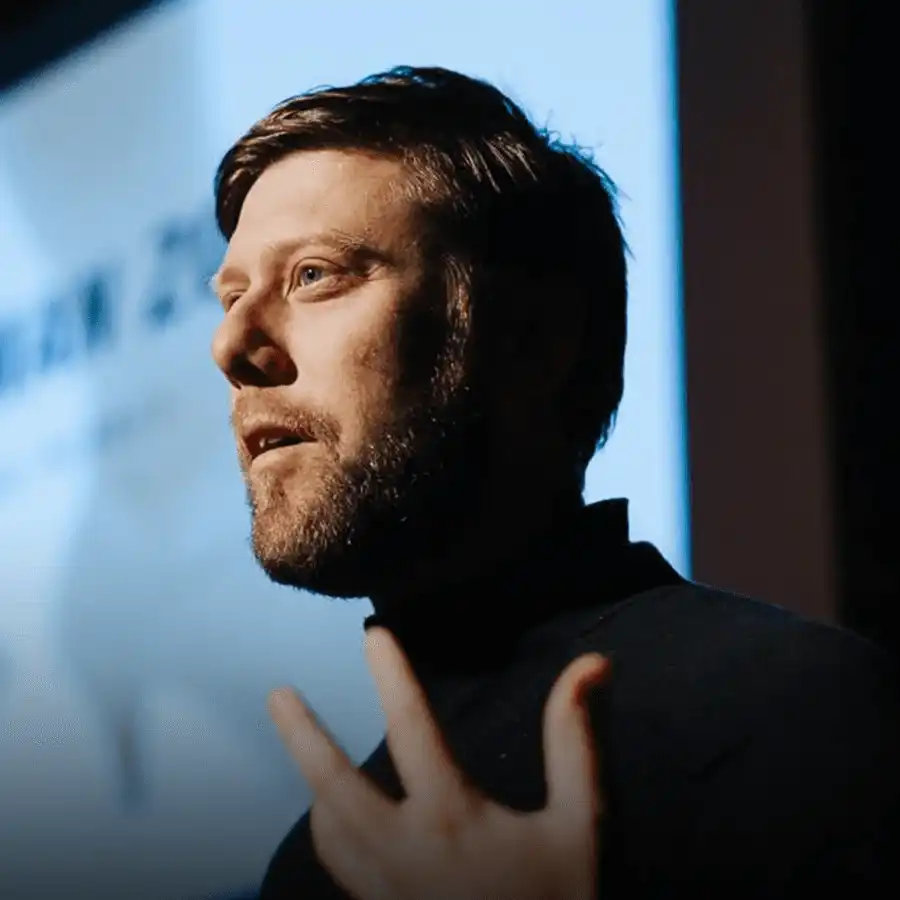
Hendrik-Jan Grievink (1977) is researcher, visionary designer and public speaker. He is part of the core team of Next Nature, a global network of creatives who share a richer notion of nature. He uses speculative design to visualise scenarios that help people and organizations make better decisions for the future, while being in the present. Thought provoking projects such as the NANO Supermarket and the In Vitro Meat Cookbook stimulate the debate on how to dream, build and live in a world where biology and technology are merging: our Next Nature.
All sessions by Hendrik-Jan →Every human on the planet is a crew member of Spaceship Earth. However, we need to re-invent the driving manual. At least if we want our species to survive, and create a future that is satisfying for the wellbeing of all humans, but also for planet Earth as a whole.
But where to start? First, we have to acknowledge that our vision of nature is outdated and needs an upgrade. We need to adopt a new paradigm where nature and technology are not opposites, but merge into a Next Nature.
We can then start to envision smart solutions to feed the planet, such as harvesting energy from our own bodies and growing meat in the lab. Where will we drive our spaceship? At least not back, but forward to nature!
In this innovative session Hendrik-Jan takes you on a journey in which you will gain new insights on nature and technology and how they are changing rapidly.
During the expert session, Hendrik Jan Grievink invites participants to share their perspectives through interactive exercises using the Mentimeter app. He discusses the relationship between nature and technology, encouraging dialogue on topics like lab-grown meat, decentralization, and technological integration into our lives.
By engaging the audience in thoughtful discussions, Hendrik fosters a collaborative learning environment that inspires new ways of thinking about our future.
Explore the concept of "next nature" by recognizing that everything beyond our control falls under this category, fostering a deeper appreciation for the natural world and its intersection with technology.
Engage in discussions on innovative food concepts, such as lab-grown meat or alternative diets like vegetarianism and insect-based diets, to reduce animal harm, overconsumption, and resource usage.
Embrace the potential of technology to transform our lives by considering its historical development and future implications, while also advocating for a more decentralized world where unique solutions emerge from various communities.
In this expert session, Hendrik-Jan Grievink, an artist and designer with a passion for exploring the future of nature and technology, introduces himself, sharing his enthusiasm for both nature and technology, setting the stage for an intriguing journey where we may reevaluate our perspectives on these concepts.
Hendrik-Jan presents the idea of our planet as a "spaceship" inhabited by humans, introducing the concept of three spheres: the geosphere (natural Earth), the biosphere (all life on Earth), and the technosphere (human-made technology). He points out that the weight of all technology exceeds the combined weight of the natural spheres.
Hendrik-Jan uses visual examples from space to discuss human activity, revealing how political systems can be perceived from above and questioning if our relationship with nature is still authentic or merely a pastime or consumption.
Hendrik-Jan invites participants to share instances where elements are both grown in nature and created by humans, leading to a discussion on topics such as cloned animals, engineered bacteria, modified plants, crops, food, agriculture, and wooden structures. The conversation expands to consider the intersection of nature and technology, with examples ranging from cars and factories to complex systems like traffic jams, the internet, and computer viruses.
Hendrik-Jan urges participants to expand their understanding of nature, suggesting that it might be more accurate to view it as everything beyond our control. He coins the term "next nature" to describe this concept and shares his art and design projects, such as the Nano Supermarket, which presents potential future products that don't yet exist but could in 10-20 years.
The session continues with Hendrik-Jan discussing the historical development of agriculture and its connection to modern practices like industrial farming and meat consumption. He reflects on the ethical considerations surrounding animal welfare and environmental impact, leading him to explore options for addressing these issues through vegetarianism, insect-based diets, and lab-grown meat.
Regarding lab-grown meat, also known as cultured or clean meat, Hendrik-Jan discusses its origins and explains the process of growing animal cells in a controlled environment to create edible tissue. He shares his team's fascination with exploring the creative possibilities of lab-grown meat through artistic presentations and design.
Hendrik-Jan also shares a personal story about how lab-grown meat could change our relationship with animals, creating a more symbiotic bond rather than a consumptive one. He encourages the audience to share their ideas for extreme recipes or innovative food concepts in a cookbook project.
Throughout the discussion, Hendrik-Jan emphasizes the potential of technology to transform our lives and reshape our lifestyles.
At the conclusion of the session, Hendrik-Jan encourages everyone to reflect on the ideas presented and he shares his vision of a more decentralized world and the potential for technology to create unique, fairer experiences across various industries.
No prior knowledge is assumed. It is built for a general working audience, and people who already know the subject get the research and the practical side rather than an introduction. What the hour itself covers: Every human on the planet is a crew member of Spaceship Earth. However, we need to re-invent the driving manual.
Hendrik-Jan Grievink is one of the experts we auditioned ourselves, and we produce every session so we see how each one lands. Participants rate this session 4.1 out of 5, across 75 responses, and rate Hendrik-Jan personally 4.3 out of 5.
It is interactive, and the block higher up on this page says exactly how for this session. Nobody has to speak up who does not want to: the chat and the polls carry most of it, and the questions can come in anonymously.
It runs 45 min / 15 min: the talk, then live questions. All you do is pick a date. We brief Hendrik-Jan, produce the session, host and moderate it, run the Q&A, and send you the report within an hour of the end.
A team, a department, an employee network or every single employee at once, with no cap and no per-seat price. It runs inside your own Microsoft Teams, Zoom or Google Meet, or on a branded page we build. No integration, no login, no company device or e-mail.
The session is delivered in English, Dutch. You can add high accuracy live subtitles in 8, 16 or 24 languages, so everyone follows in their own. That is a paid option, priced by the number of languages you need.
No, and that is by design. There is nothing to install, nothing to integrate and no connection to your systems, so there is nothing for IT to validate: we join your own Teams, Zoom or Meet as a guest speaker, or we host a page and your people open a link. No software, no accounts, and no data of yours that we can reach. It is why hundreds of companies, among them some of the largest technology and financial firms in the world, were able to start within a day.
We never receive or hold personal data about your employees. Because the session runs in your own environment, attendance and identity stay with you, and what we report back is aggregated: numbers, ratings and survey answers, not people. That is also why IT approval usually takes minutes rather than weeks.
You keep the recording and can share it internally. You also get attendance over time, participant ratings for the content and the speaker, the survey answers, and the topics your people asked for next.